

Highlights
| English for logistics key phrases is the focus of this practical vocabulary guide for professionals working in supply chain, warehousing and transport. It covers the key terminology, useful phrases for handling shipments, coordinating with drivers and managing customer queries, alongside how employers build these skills across a multilingual team. |
If you work in logistics, you already know that clear communication is what keeps freight moving. A missed detail on a delivery note or a misread instruction at a handover turns into a delay, and delays cost money. For people doing that work in a second language, the right vocabulary makes the difference between a shift that runs smoothly and one that does not. This guide covers the logistics vocabulary and phrases you will use every day, from handling shipments and coordinating with drivers to managing customer queries, and it sets out how employers build these skills across a whole team where English is not everyone’s first language.
| Read how Samar Internacional transformed their logistics team. |
Why Should You Learn English for the Logistics Industry?
English is the universal language of international business, and in logistics, it connects teams, clients, and suppliers around the world. Without it, communication breakdowns can cause delays, misunderstandings, and even lost shipments. That’s why learning English for logistics is such a valuable skill, it helps you keep everything moving smoothly and efficiently.
Mastering English for logistics isn’t just about being able to talk the talk, it opens up a whole world of opportunities! By improving your language skills, you’ll be able to:
- Communicate clearly with international partners, reducing errors.
- Handle customer questions and concerns confidently.
- Negotiate better terms with suppliers and freight forwarders.
- Stay informed about the latest trends and developments in the logistics industry.
Imagine becoming the go-to person in your company for managing international shipments or navigating complex supply chain processes. That could be you with the right English skills!
Expanding Your Logistics Vocabulary
Knowing the right words and phrases will make your daily tasks much easier and boost your confidence. Let’s look at some of the key terms you’ll use often in logistics:
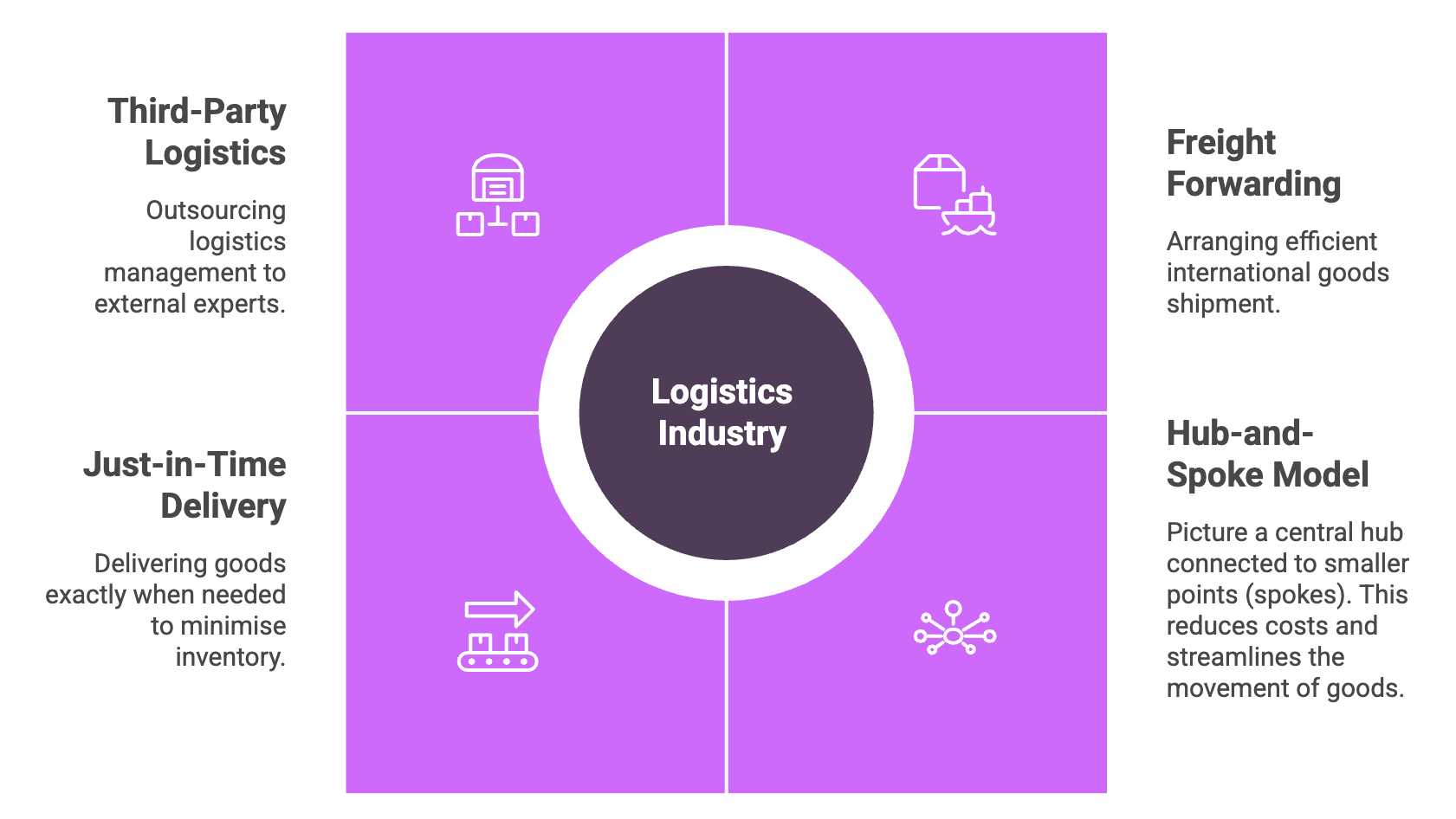
- Third-Party logistics: Outsourcing logistics management to external experts.
- Just-in-Time Delivery: Delivering goods exactly when needed to minimise inventory.
- Freight Forwarding: Arranging efficient international goods shipment.
- Hub-and-Spoke Model: A central hub connected to smaller points (spokes). This reduces costs and streamlines the movement of goods.
Learning these terms will help you understand the logistics industry better and communicate more effectively with colleagues, clients, and suppliers.
Top Tip: Write down these words in sentences related to your day-to-day tasks. This will help them stick in your memory!
Key Logistics Vocabulary: English Phrases for Supply Chain and Transport
If your job involves moving goods or managing the supply chain, you’ll need to be comfortable with specific phrases. Here’s a list of useful phrases to help you navigate these areas:
Lead Time: This refers to the time it takes to complete a process, from placing an order to making the delivery. Knowing your lead times is crucial to avoiding delays and ensuring smooth operations.
Procurement: The process of obtaining goods or services from suppliers. It’s a critical first step in the supply chain, ensuring that the rest of the process runs smoothly.
Inventory Management: Keeping track of stock levels and making sure you don’t have too much or too little. Good inventory management helps prevent costly mistakes.
Order Fulfilment: This covers everything from receiving the order to picking, packing, dispatching, and delivering the goods. A smooth order fulfilment process is key to customer satisfaction.
Distribution Network: The system that moves goods from suppliers to customers. A well-organised distribution network ensures on-time delivery at the right cost.
Once you’re familiar with these terms, you’ll find it much easier to stay on top of your responsibilities and communicate with your team, clients, and suppliers.
Common Logistics Abbreviations
Logistics runs on shorthand. You will see these on delivery notes, in emails, on screens and over the radio, so it helps to know them before your first shift.
| Abbreviation | What does it stand for? | What does it mean? |
|---|---|---|
| ETA | Estimated Time of Arrival | When a shipment or driver is expected to arrive |
| ETD | Estimated Time of Departure | When a shipment or vehicle is expected to leave |
| POD | Proof of Delivery | A signature or confirmation that goods were delivered |
| BOL | Bill of Lading | The document listing what is being shipped, from whom and to whom |
| SKU | Stock Keeping Unit | A unique code for each product in stock |
| FIFO | First In, First Out | Stock that arrives first is used or sent first |
| 3PL | Third-Party Logistics | A company that handles storage and shipping for another business |
| LTL | Less Than Truckload | A shipment too small to fill a whole truck |
| FTL | Full Truckload | A shipment that fills a whole truck |
| WMS | Warehouse Management System | Software that tracks stock and tasks in the warehouse |
| TMS | Transport Management System | Software that plans and tracks deliveries |
| HGV | Heavy Goods Vehicle | A large lorry or truck |
| ADR | European agreement on the international carriage of Dangerous goods by Road | Rules and a licence for transporting hazardous goods by road |
Top Tip: Write each abbreviation on a card with the full phrase on the back. Test yourself for five minutes before your shift.
Must‑Know English Vocabulary for Logistics Professionals
Now let’s dive into some practical phrases that will help you every day:
Handling Shipments:
“What is the estimated time of arrival (ETA)?” – To ask when a shipment will arrive.
“Has the monthly invoice been issued?” – To check if the invoice for the shipment has been sent.
Warehousing:
“Is the inventory up to date?” – To confirm if stock records match the physical inventory.
“How many pallets are ready to be dispatched?” – To plan outgoing shipments.
Problem-Solving:
“Can we reroute the shipment?” – When unexpected delays occur, this helps find alternative routes.
“What are the customs requirements for this destination?” – To ensure your shipment clears customs smoothly.
Communication with Drivers:
“Are there any delays on the route?” – To check the status of the shipment in transit.
“Please confirm when the delivery has been completed.” – To confirm that the shipment has arrived safely.
Coordination with Clients and Suppliers:
“Can you provide the shipment’s tracking number?” – To ensure everyone knows the current status of the shipment.
“What are the payment terms for this order?” – To discuss the financial details of the shipment.
English for Supply Chain Management
Logistics moves the goods. Supply chain management plans the whole journey, from supplier to customer, so these roles use more written English and more negotiation. Key terms:
- Purchase order (PO): a formal request to a supplier to buy goods
- Demand forecast: an estimate of what customers will order
- Replenishment: refilling stock before it runs out
- Stockout: an item is unavailable because stock has run out
- Backorder: an order that will be sent when stock arrives
Try these: “Can you confirm the lead time on this PO?” / “We’ll have a stockout by Friday if the delivery slips.”
Phrases for Shift Handovers and Safety Briefings
Handovers are quick and informal, which is why they fail when English is a second language. The most effective fix is simple: the incoming worker repeats the key points back, and the outgoing worker confirms.
“Bay 4 is blocked. Please don’t use it until maintenance has checked it.”
“Three pallets are still waiting to be dispatched.”
“Can you repeat that back to me, please?”
“Stop work and tell your supervisor if the load isn’t secure.”
Handovers are one of four moments where language gaps create safety risks. Our guide to safety briefings and shift handovers covers all four, and shows which problems a supervisor can fix with better process and which need targeted English training.
About Everywhere English
| Everywhere English provides workplace English training for businesses with multilingual teams. Founded in Ireland in 2022, we tailor each program to the company’s specific industry and team’s roles. Training combines live online teaching and self-paced learning through our digital platform so that learners improve their communication skills fast and effectively. We work with organisations across Ireland, Northern Ireland and the UK. |
When English is a Whole Logistics Team’s Problem, Not One Person’s
Everything above helps an individual sound more confident on shift. The bigger issue for most operators is a whole team that needs to coordinate in English across warehousing, transport and the front desk, often across several first languages and several sites. That is where the cost sits. A misheard instruction on a loading bay, a customs form filled in wrongly, a handover that loses a detail between the day and night shift, each one is a delay, a cost or a safety risk, and no amount of individual vocabulary drilling fixes it on its own.
This is the work we do with logistics and supply chain companies across Ireland, Northern Ireland and the UK. We build the training around your operations, so warehouse staff learn the language of picking, packing and safety, coordinators get the wording to manage shipments and schedules, and transport teams get the English for delivery instructions, forms and customs. It runs online and around your shift patterns, so training reaches every site and every rota without pulling anyone off the job. You can see how that works on our English for Logistics programme, and if you are weighing up how workplace training is set up and funded, our guide to English training for employees covers it from the employer’s side.

Frequently Asked Questions
Is there a logistics vocabulary PDF?
Yes. This is our free guide for multilingual staff, English for Logistics & Supply Chain, covers the top 50 words used in the industry, each with a simple definition and an example sentence.
If you’re an HR manager or operations lead, clear communication across your team isn’t just a nice-to-have, it directly affects safety, efficiency, and retention.
We’ve put together a free practical guide: “Keeping Operations Moving: A Practical Guide for Clear Communication in Multilingual Logistics Teams” which is packed with actionable strategies you can put to work straight away. You can download the free guide here.
What is the difference between logistics and supply chain?
Logistics is about moving and storing goods: transport, warehousing, packing and delivery. Supply chain is the bigger picture. It covers everything from sourcing raw materials through production to the customer, and logistics is one part of it. For example, a driver delivering pallets works in logistics, while the whole journey from supplier to shop shelf is the supply chain.
Which English phrases do warehouse workers need most?
Warehouse workers use short, practical phrases for four situations:
- Checking stock: Is this the right SKU? / Is the inventory up to date?
- Moving goods: Where should this pallet go? / How many pallets are ready to be dispatched?
- Staying safe: Watch out! / Stop, please. / Is this load secure?
- Asking for help: Can you say that again, please? / Can you show me?
What English level do logistics workers need?
The level depends on how much a role speaks, writes and solves problems in English. These are guidelines, because every site is different. Levels follow the CEFR scale (A2 is basic, B1 is intermediate, B2 is upper-intermediate, C1 is advanced).
| Role | Typical level | What they need to do in English |
|---|---|---|
| Warehouse operatives, pickers, packers | A2 – B1 | Follow safety instructions, read labels and pick lists, ask for help |
| Drivers and loaders | A2 – B1 | Understand delivery instructions, report delays, complete delivery documents |
| Team leaders and shift supervisors | B1 – B2 | Run handovers and briefings, explain problems, give clear instructions |
| Transport coordinators, dispatchers, customer service | B2 | Handle calls and emails, manage queries and complaints, rearrange deliveries |
| Planners, procurement, freight forwarding and customs | B2 – C1 | Negotiate, write detailed emails, handle contracts, forms and regulations |
Not sure where you or your team are? Contact us to book an assessment and we will place each person at the right level.
Our English Course for Logistics trains warehouse teams on exactly this kind of language, around their shift patterns.
Ready to Take the Next Step in Learning English for Logistics?
Improving your English for logistics doesn’t have to be difficult. You can make it part of your daily routine! Here are a few tips to help you get started:
Set aside just 15 minutes a day to learn new phrases or revise the ones you already know.
Practise with colleagues who are also learning. It’s a fun and supportive way to improve together.
Listen and read! Podcasts, videos, and articles about logistics will help you hear real-world examples of vocabulary in action.
| For extra help, download the Logistics Guide PDF from Everywhere English! It contains the top 50 vocabulary terms you need to thrive in logistics. |
Why Learn English for Logistics with Everywhere English?
We help professionals build the practical English they need for logistics work, with lessons based on real supply chain scenarios rather than textbook exercises. For an individual, that means more confidence on shift and a stronger position for promotion. For an employer, it means fewer errors, safer handovers and a team that coordinates cleanly across sites and shifts.
If you are an HR or learning and development manager, our Logistics training is built around your operations and your team’s real gaps
Share a few details about your team and we will put together a training plan based on how your logistics operation actually runs.