

Highlights
| For most organisations, external Business English training outperforms in-house programmes on flexibility, cost, and results, and this guide explains why. It covers the advantages of sector-specific external delivery, when in-house training makes sense, how costs compare over time, available funding through schemes such as Skillnet Ireland and FUNDAE, and a real-world example from ESS Ltd. |
Did you know that lack of time and high training costs are the top barriers blocking small and medium-sized enterprises from effective in-house programs, driving most to partner with external specialists.
Business English training delivered by a specialist external provider is often more flexible, targeted, and cost‑effective than building an in‑house language programme.
In‑house programmes still have a place in organisations mature L&D structures, but they are harder to scale and maintain, and can be more expensive per learner.
Read below to see how partnering with Business English experts like Everywhere English delivers better results, faster.
External Training: Key Advantages
Sector-Specific, Flexible Delivery
A specialist Business English provider can build sector‑specific curricula (for manufacturing, logistics, pharma etc.) that directly reflect a company’s SOPs, safety policies, and customer communication scenarios. This ensures learners practise the exact language needed on the factory floor, in warehouses, during audits, or in customer interactions, rather than generic textbook English.
At Everywhere English, an in‑depth onboarding process is considered fundamental, and it starts with understanding our client’s workplace in detail. Using a dedicated questionnaire, the team gathers information about the tasks employees perform and the situations in which they need English the most. Throughout this needs analysis stage, the manager or project lead helps clarify when, how, and why employees use English at work, so the training plan reflects their real communication needs.
We then analyse each learner’s needs in a one‑to‑one setting, assessing their current level and identifying specific gaps in their skills. Our experienced tutors design a tailored training plan which takes into account the goals of both the employee and the employer, ensuring the best possible results.
Flexibility is a core feature throughout the programme. If new priorities emerge, such as an audit, a process change, or a presentation, lesson content can be adjusted quickly to support immediate workplace demands.
In-House: When It Works
In‑house programmes can be effective when a company has a large, stable population of learners, internal L&D capacity, and a budget to hire experienced language training staff. Bigger organisations that already run corporate academies or internal training centres sometimes integrate English into existing structures as part of a wider skills strategy
However, designing and maintaining an in‑house language curriculum requires significant time for needs analysis, material creation, assessment design and teacher training. There is also a risk that internal programmes become inconsistent if trainers leave or if language teaching is added to someone’s existing role without giving them enough time and support.
Cost Comparison at a Glance
When comparing in‑house language programmes with external Business English training, it helps to look beyond headline prices and consider how costs behave over time. The table below summarises the main differences in cost structure, scalability, and access to funding between in‑house and outsourced options.
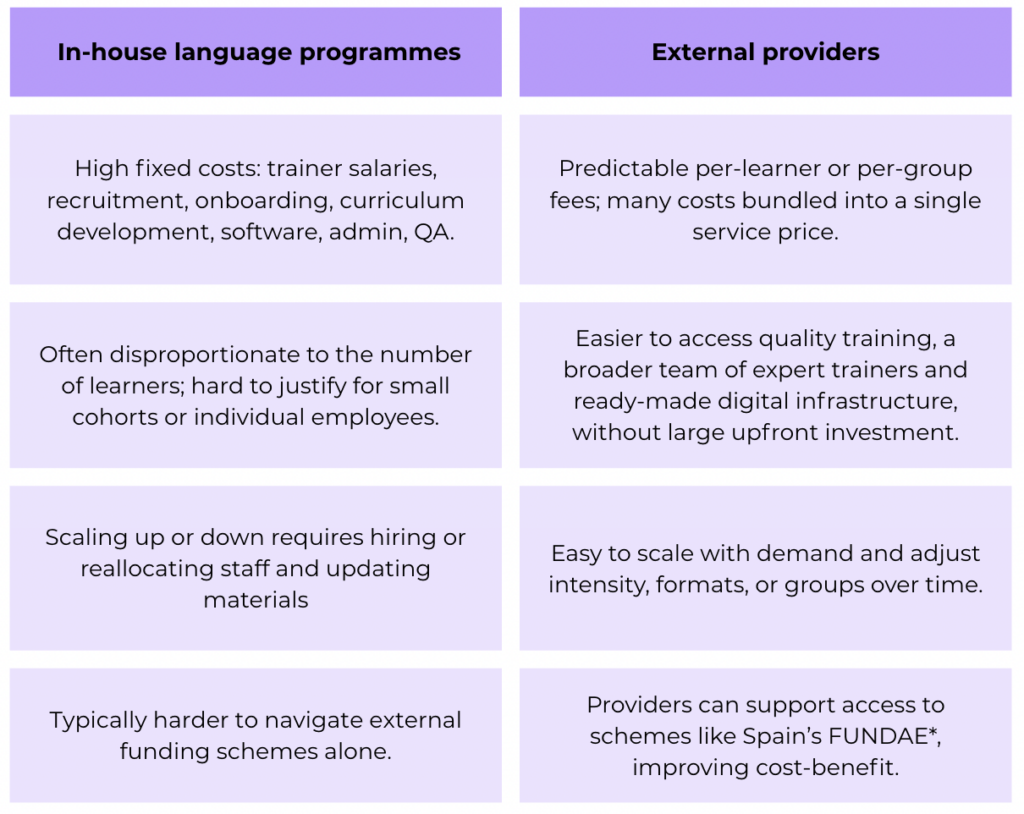
External providers can also help organisations tap into government‑funded upskilling schemes, further improving the cost–benefit ratio. In Spain, for example, language training can be subsidised through FUNDAE, the national system that finances professional training for employment using employer and employee social security contributions, State Employment Service funds, regional budgets, and EU co‑financing. Everywhere English has supported the Spain‑based international supply chain company Samar in providing 1‑to‑1 English tuition for employees, with courses subsidised through FUNDAE so staff can build confidence and communication skills at a significantly reduced cost to the business.
Another Example is here in Ireland, Irish companies can avail of a 20% discount on language training through Skillnet Ireland and Everywhere English, reducing the cost to the business.
Book your free needs analysis to discover funding eligibility.
Real Results: ESS Ltd’s external Business English training
ESS Ltd is a business services and outsourcing company that places skilled professionals into roles across Ireland, with a strong focus on helping newcomers integrate at work and in the wider community. Although many of their international hires had solid English, they lacked confidence with everyday conversations, technical discussions, and colloquial language, which made settling into a new role more challenging.
Everywhere English partnered with ESS to deliver one‑to‑one Business English courses as part of the onboarding process for newcomers, focusing on conversational fluency, workplace vocabulary, cultural nuances, and real‑world communication scenarios.
As a result, employees now feel more confident in both meetings and informal conversations, communication has improved in technical discussions, and ESS has received positive feedback from customers on the communication skills of placed candidates.
As ESS’s HR lead put it, “Absolutely, I would recommend Everywhere English – very friendly, great communication, and the employees gain so much from it. We’ve seen measurable improvements in client satisfaction since our team began the sector-specific English training.”
Choosing between Business English training and an in‑house language programme ultimately comes down to capacity, priorities, and the level of impact you want to see on day‑to‑day operations. For most smaller organisations with limited L&D bandwidth, partnering with a specialist external provider offers clearer costs, faster implementation, and training that is closely aligned with real workplace communication.
If you would like to explore what this could look like for your team, Everywhere English can help you analyse your needs, design a tailored programme, and advise on possible funding options such as national upskilling schemes.
You can book a free call or get in touch via the English for Businesses page or the contact form on the Everywhere English website.
Sources
- OECD. (2024). Training in enterprises. https://www.oecd.org/en/publications/training-in-enterprises_7d63d210-en.html
- Skillnet Ireland. (n.d.). Skillnet Ireland initiatives. https://www.skillnetireland.ie/initiatives