

Summary: English training for manufacturing teams in Ireland typically costs between €2,200 and €5,600 per employee annually, with Skillnet Ireland funding covering 20% of that figure. Irish manufacturers consistently report full ROI within 8–12 months through reductions in safety incidents, quality errors, and the supervisor time lost to daily miscommunication. Everywhere English delivers industry-specific programmes with weekly live sessions, a 24/7 self-study platform, and monthly progress reports for HR teams.
Manufacturing companies in Ireland lose thousands of euros every month to something most finance teams never see on a report: language gaps. A misread batch code. A safety warning that didn’t land. A shift handover that took 40 minutes because two supervisors couldn’t fully understand each other.
On average, a workplace safety incident in manufacturing costs between €12,000 and €35,000 when you factor in lost production time, investigation, retraining, and potential regulatory penalties. And that’s before anyone considers the human impact.
The question most operations managers ask isn’t whether to invest in English training. It’s what English training for manufacturing costs, and whether the numbers stack up. Here’s what they look like.
What Is Poor Communication Costing Your Factory?
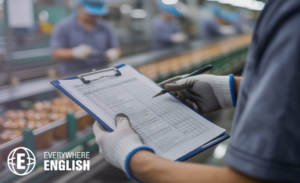
Imagine a food production facility in Wexford facing these challenges. For example, thirteen line workers with A2-level English (pre-intermediate) might generate the following costs in a single month: six batch-coding incidents causing €2,400 in wasted materials; 18 SOP errors requiring supervisor intervention, totalling €1,215 in supervisor time at €45 per hour; daily shift-handover delays across two shifts costing €840 in accumulated downtime; and four workers needing safety retraining at a combined cost of €224.
Monthly total: €4,679. Annual cost: €56,148. For one production line.
How much is yours losing? Tracking it is also the first step toward calculating your English training manufacturing cost and building a Skillnet funding case. The English for Manufacturing programme at Everywhere English starts with a proficiency assessment that also helps you pinpoint where communication gaps are hitting the hardest.
What Does English Training for Manufacturing Actually Cost?
When businesses start researching English training manufacturing cost, the first question is usually what a full programme actually includes. A well-structured 12-month programme for a manufacturing team of 20 typically covers initial proficiency assessments, a curriculum built around your sector’s specific language demands, weekly group sessions, self-study platform access, and quarterly progress reviews.
For companies looking to test the approach before committing long‑term, we also offer a 6‑month pilot course. This pilot includes the same core components – assessments, tailored group sessions, and progress tracking, but on a shorter timeline, allowing your teams to experience the impact of the training and gather measurable results before scaling up to a full‑year programme
That sounds significant. But here’s what changes the calculation entirely.
Skillnet Ireland funds 20% of approved training costs for private-sector manufacturers. Irish Medtech Skillnet, Food & Drink Skillnet, Polymer Technology Skillnet, and Engineering Skillnet all cover workplace English as a qualifying skills programme. After funding, a €111,000 programme for 20 employees drops to €88,800, or €4,440 per person.
Applications are processed within four to six weeks. Network managers help structure your submission and, because language gaps in manufacturing directly affect safety, quality, and compliance, the business case practically writes itself.
How to Calculate Your ROI Before You Apply
You don’t need a formal audit to build a business case. One month of careful tracking across four areas gives you everything finance needs.
Production errors. Count incidents where a language barrier caused incorrect materials to be used, wrong specifications to be followed, quality checks to be missed, or batch-processing mistakes. Add up materials wasted, labour to correct, and any customer returns.
Supervisor time. Log the hours your supervisors spend re-explaining instructions, resolving miscommunications, or standing in as informal translators. Multiply by their hourly rate. This number surprises most operations managers.
Safety incidents. Track near-misses and incidents where a safety warning wasn’t understood, PPE wasn’t applied correctly, or emergency procedures weren’t followed. Even one serious incident costs tens of thousands of euros. The Health and Safety Authority’s published data puts the average cost of a workplace injury in Ireland at €25,000.
Lost productivity. Measure time spent asking colleagues to translate, double-checking whether instructions were understood, or redoing incorrect work. Even 15 minutes per shift, per worker, adds up to significant annual losses across a full production team.
A pharmaceutical manufacturer in Cork, for example, could track these four areas for 24 employees and find total language-related costs of €8,000 per week. At that rate, a training investment of €134,400 (after Skillnet funding) would pay for itself in a little over 5 months. You can read more about how communication impacts compliance in high-stakes manufacturing in our guide to pharmaceutical industry English training.
What the Evidence Actually Shows
Because real client data is commercially sensitive, the honest approach is to look at what independent research tells us about the scale of the problem and the direction of the returns.
| Finding | Source |
| Language barriers contribute to 25% of all job-related accidents | OSHA (US Dept. of Labor) |
| Median cost of a workplace accident in Ireland: approx. €10,000 | HSA Ireland / Millward Brown employer survey |
| Average employer liability award in Ireland: €22,545 (2022) | Personal Injuries Assessment Board (PIAB), cited by Ayrton Group |
| True claim cost is 1.8x the direct payout once indirect losses are included | State Claims Agency Ireland, 2024 |
| 94% of employees would stay longer if their employer invested in their learning | LinkedIn Workplace Learning Report (2018) |
| 96% of HR and L&D leaders say language training helps retain staff | British Council / English Online, 2025 |
| Cost of one preventable safety incident often exceeds the annual cost of training an entire team | Babbel for Business, citing safety research |
The argument for English training in manufacturing isn’t built on projected ROI percentages from unnamed companies. It’s built on what safety authorities, HR researchers, and workplace insurers tell us about what language barriers actually cost, and what removing them is worth. You can read client stories from companies who have been through this process on the Everywhere English client stories page.
What Shapes Your Training Budget
Four factors will move your costs up or down, and it’s worth understanding each before you request quotes.
Your team’s starting proficiency level is the biggest variable. A team at A1 (beginner) generally needs around 18–24 months of structured training to reach B1 (intermediate), while a team at A2 (elementary/pre-intermediate) typically reaches B1 in about 12–15 months, assuming consistent weekly classes and some self‑study. An initial assessment costs €50–€150 per person and sets the baseline for progress tracking and funding applications
Shift patterns matter too. Standard day shifts allow consistent weekly sessions at the lowest delivery rates. Multiple rotating shifts require flexible scheduling, which typically adds 15–20% to costs. Many manufacturers handle this by running sessions during shift changeovers, with both the outgoing and incoming teams attending a shared 60–90-minute session.
Industry-specific content adds a modest premium (roughly 15% over generic business English) but delivers faster results because your team is working with vocabulary they encounter every single day: safety data sheets, machine operating procedures, batch records, audit language. It’s the difference between learning English and learning the English your job requires. See how this plays out in a logistics context in The English for Logistics Training Your Team Actually Needs.
Finally, blended learning consistently outperforms weekly sessions alone. Adding access to a self-study platform (€15–20 per person per week) roughly doubles the rate of proficiency improvement because learners practise daily rather than once a week.
Training That Works Around Production
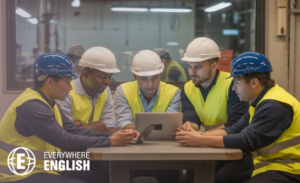
The most common objection to factory English training is a practical one: you can’t stop the line. But the programmes that deliver the strongest results are specifically designed not to.
Shift changeover sessions are the most popular structure in Irish manufacturing. Both teams attend a 60–90 minute session: the outgoing shift stays 30–45 minutes over, the incoming shift arrives early. The shared context (same factory, same machinery, same daily language needs) makes the training immediately relevant.
Weekly fixed sessions work well when there’s a predictable quiet window, early Monday mornings or Friday afternoons during maintenance periods. Consistency matters far more than timing. Irregular sessions undermine momentum and hurt completion rates.
The blended learning model at Everywhere English combines weekly instructor-led sessions with a 24/7 self-study platform, allowing learners to continue learning between live classes. HR managers get a real-time dashboard that shows attendance, grades, and individual progress, making monthly reporting to management straightforward.
Making the Business Case to Finance
The strongest proposals follow a simple three-part structure: here is what the problem is costing us now, here is what the solution costs (after Skillnet funding), and here is a conservative projection of the savings.
Use your one-month tracking data and multiply by 12 for the annual impact. Then project a 40% reduction in those costs after 12 months of training. Manufacturing managers consistently get approval when the projected payback sits under 18 months. Most programmes deliver full ROI faster, but conservative numbers build credibility.
One more thing worth including: the retention argument. Skill shortages in Irish manufacturing are acute, and replacing a trained production worker can cost between €5,000 and €15,000 in recruitment, onboarding, and lost productivity. According to LinkedIn’s Workplace Learning Report, 94% of employees say they would stay longer if their employer invested in their development. English training is often the most visible and tangible investment a manufacturer can make for a multilingual workforce.
For companies that may qualify for government-supported programmes, it’s also worth exploring government-funded English training options through Everywhere English, which covers programmes for organisations working with SOLAS, Skillnet Ireland, and other public-sector funding streams.
Ready to See the Numbers for Your Team?
Start by tracking your language-related costs for one month. That single month of data is enough to build a funding application and a management proposal.
Then get in touch. Everywhere English will carry out an initial proficiency assessment for your team, help you identify the right Skillnet network for your sector, and design a programme built around your production schedule and your team’s actual language needs.
Book a free consultation at everywhereenglish.eu/contact-us and let’s work out what the numbers look like for your factory.