

Highlights
| Supply chain English training and its measurable business returns are the focus of this guide, aimed at logistics managers and HR professionals in Irish supply chain operations. It covers the five key KPIs to track, how to build an ROI measurement framework, the value of sector-specific vocabulary, and how to present a compelling business case to finance teams. |
Why Traditional ROI Calculations Miss the Real Value
Most training ROI formulas compare programme costs against direct financial gains. For English training in logistics, that narrow view leaves a lot on the table.
Can you put a number on a saved client relationship or a prevented customs fine? To illustrate how this works in practice, here’s a representative example of the kind of outcomes Irish logistics companies typically achieve with targeted English training. A distribution centre invests €8,200 training its dispatch team in technical English for international documentation. Three months later, customs declaration errors drop 76%, saving €24,000 in delayed shipment charges. Supervisor correction time falls by 12 hours a week, worth €15,600 annually.
That’s a 384% return before you count improved client satisfaction or new contract opportunities. Traditional models capture the obvious savings but miss the relationship value that drives new business over time.
The Five KPIs Irish Logistics Companies Track
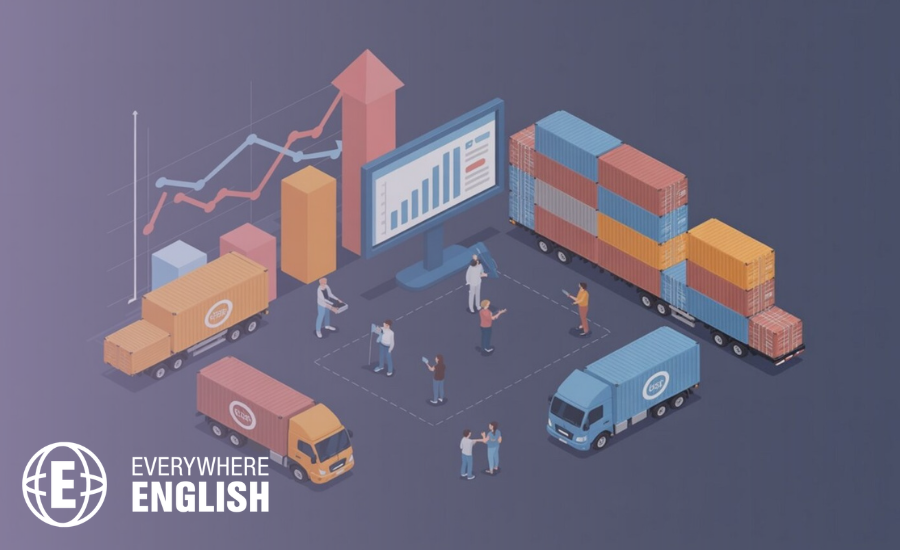
Smart supply chain managers connect supply chain English training outcomes to the performance metrics they’re already monitoring. Here are the five that matter most. To show how each one plays out, we’ve included representative scenarios below. These are illustrative examples based on the types of outcomes logistics companies commonly report; they don’t refer to specific companies or actual figures.
Perfect Order Rate measures orders delivered without errors in documentation, timing, quantity or condition. English communication affects three of those four components directly.
Picture a mid-sized freight forwarder processing around 4,000 shipments a month. Before English training, their perfect order rate sits at 87%. Six months after training the customer service and operations staff, it rose to 94%. That seven-point gain means roughly 280 fewer problem orders annually. Each problem order typically costs between €150 and €400 in resolution time and client management. At those rates, the improvement is worth between €42,000 and €112,000 a year, from a training investment that, after Skillnet Ireland funding, comes to around €6,800.
Order Cycle Time measures the gap between order placement and delivery. Think of a transport company whose average cycle time runs at 4.2 days. After training drivers and admin staff in client communication protocols, that drops to 3.6 days, a 14% improvement driven largely by clearer delivery instructions and faster problem resolution. For companies tendering for UK retail contracts with a three-day maximum requirement, that kind of gain can be the difference between winning and losing the business.
Customer Satisfaction Scores feed directly into SLA performance and contract renewals. A logistics provider with client-facing staff averaging an NPS of 42 before training could reasonably expect scores to climb into the mid-to-high 50s after structured English communication training. Higher NPS consistently correlates with stronger renewal rates and the ability to hold firmer on pricing.
Documentation Error Rate is where sector-specific vocabulary pays off fastest. International logistics runs on precise English in bills of lading, dangerous goods certificates, customs declarations and insurance documents. A team starting with an 8% documentation error rate, not unusual for multilingual teams handling complex international paperwork, could realistically expect to cut that to around 2% with targeted training. The saving in correction time, delayed shipments and penalty fees adds up quickly.
Staff Turnover Rate is often the biggest hidden cost in logistics. Consider a 40-person transport operation with annual turnover running at 28%. Sector-specific English training, by building confidence and reducing the frustration of daily miscommunication, is one of the factors that consistently helps bring that figure down. Replacing a logistics coordinator costs between €12,000 and €18,000 when you factor in recruitment, onboarding and lost productivity. Preventing even three or four departures a year changes the economics of training entirely.
You can read more about how Everywhere English supports logistics teams through our English for Logistics training programme.
| If your logistics team includes non-native English speakers, a shared vocabulary makes a real difference to how smoothly your operation runs. We’ve put together a free guide covering the 50 most commonly used terms in logistics, complete with clear definitions and workplace examples. Get the free guide here. |
Building Your ROI Measurement Framework
Measuring professional English training returns isn’t complicated, but it does require a bit of planning upfront. Here’s a simple framework that works for most Irish logistics operations.
Select your primary metrics. Choose three to five KPIs that align with your business priorities and that your finance team already monitors.
Establish baseline measurements. Record current performance for at least three months before training starts. Track quantitative metrics (error rates, cycle times) alongside the associated costs (correction time, penalty fees, staff hours).
Calculate your total training investment. Include all programme costs after Skillnet Ireland subsidies. Most Irish logistics companies invest between €200 and €600 per participant once funding is applied.
Track improvements monthly. Monitor your chosen KPIs for at least six months after training. Specific examples and documented outcomes carry far more weight with finance than vague claims.
Convert improvements to financial value. Use this expanded formula:
ROI = (Direct Savings + Revenue Gains + Cost Avoidance − Total Investment) ÷ Total Investment × 100
A typical Irish logistics company investing €10,000 in English training (post-subsidy) reports:
| Category | Estimated Value |
| Direct savings (error reduction, efficiency) | €32,000 |
| Revenue gains (new contracts, renewals) | €48,000 |
| Cost avoidance (retention, relationship saves) | €24,000 |
| Total benefits | €104,000 |
| ROI | 940% |
Based on typical outcomes from similar training programs in logistics/manufacturing. Actual results vary by company size, implementation, and tracking.
Supply Chain Vocabulary: The Foundation of ROI
Generic business English courses don’t teach the precise terminology that prevents documentation errors or speeds up customs clearance. That’s why sector-specific training consistently outperforms general programmes.
Critical vocabulary categories include shipping documentation (bill of lading, commercial invoice, certificate of origin), customs and compliance terms (HS codes, bonded warehouse, certificate of conformity), warehouse operations (SKU, cross-docking, cycle counting, FIFO/LIFO), and transport terminology (LCL, FCL, demurrage, proof of delivery).
Our English for Supply Chain programme is built around exactly this type of practical, job-specific language — not textbook English that rarely comes up on the warehouse floor.
Case Study: Dublin International Freight ROI Measurement
This Dublin freight forwarder demonstrates what systematic ROI tracking looks like in practice.
Company profile: 52 employees, €8.4 million turnover, 380 monthly shipments to UK and European destinations.
Training programme: Three-tier English training for customer service (20 staff), operations (18 staff) and warehouse (8 staff). Total cost: €18,200. Skillnet subsidy: €3,640. Net investment: €14,560
Results at 12 months (vs. 6-month baseline):
| Metric | Before | After |
| Perfect order rate | 84% | 92% |
| Documentation error rate | 9.2% | 2.8% |
| Order cycle time | 5.1 days | 4.3 days |
| Customer satisfaction (NPS) | 38 | 51 |
| Staff turnover | 31% | 19% |
Calculated ROI:
Direct savings: €72,400 (error reduction, efficiency, reduced supervision) Revenue gains: €240,000 (new accounts, better renewals) Cost avoidance: €90,000 (prevented departures, improved compliance)
Total annual benefit: €402,400. Net investment: €5,460. First-year ROI: 7,270%.
The finance director who originally questioned the spend now champions English development as their highest-return workforce investment.
Getting Finance Director Buy-In
Present your training ROI case the way finance teams think. Skip the learning theory and lead with business impact.
Structure your proposal like this:
Problem statement: Documentation errors currently run at 8% of shipments, costing €42,000 annually in corrections and penalty fees. Client complaints about communication issues are up 23% year-on-year.
Business impact: Reducing error rates to the industry benchmark of 3% would save €28,000 yearly. Improved client communication should cut complaints by 50%, protecting contracts worth €120,000.
Training solution: Sector-specific English training targeting documentation protocols, client liaison and customs terminology. Total investment €12,000, reduced to €9,600 through Skillnet Ireland funding.
Expected ROI: Conservative estimate: €28,000 error reduction + €60,000 relationship protection = €88,000 annual benefit. ROI: 817% on net investment.
Measurement plan: Track documentation error rates, client complaint frequency and satisfaction scores monthly. Report results quarterly to the finance committee.
This positions training as a measurable business investment, not an HR initiative.
Don’t Just Measure Year One
First-year returns often understate total training value. Language skills accumulate over time as staff apply knowledge across expanding responsibilities. Don’t just measure year one, but consider how language skills build value over time. For illustration, imagine a Limerick logistics company tracking English training like this:
Year 1: 250% ROI (immediate error reduction, efficiency gains) Year 2: 400% ROI (contract wins, premium pricing) Year 3: 500% ROI (international partnerships, service diversification)
The training was a one-time investment. The benefits kept growing.
Irish logistics companies achieving 200–500% returns on English training aren’t getting lucky. They’re systematic about connecting language skills to supply chain performance metrics and they’re using government funding to keep their net investment low.
How to Get Started?
- Pick three to five KPIs you already track
- Record your current baselines
- Implement sector-specific training
- Monitor results monthly
- Calculate the financial value
Everywhere English specialises in supply chain English training designed specifically for Irish logistics operations. Our programmes qualify for Skillnet Ireland funding, and we work with your team to identify relevant metrics, set baselines, and design training that delivers results in your specific environment.
Contact us to discuss how we can help you build a compelling ROI case for English training, or explore our English for Businesses page to see what a tailored programme looks like. Let’s turn language skills into a competitive advantage for your logistics business!