

Highlights
| English for construction is workplace language training for site teams whose first language is not English. It covers safety instructions, toolbox talks, machinery and materials vocabulary, and the everyday communication that keeps a site running and compliant. Courses run online around site hours, work for mixed-nationality crews at different levels, and group training starts at €80 per learner per month. It is bought by contractors, subcontractors and recruiters in Ireland, Northern Ireland and the UK who need international workers safe, understood and productive from their first day on site. |
This guide explains what a course covers, how it connects to Safe Pass and CSCS requirements, how training fits around a 7 am start, and what it costs. Everywhere English delivers this as part of our training for businesses across Ireland and the UK.
Why Construction Sites Run on English
Construction is one of the most international industries in Ireland and the UK, and it is also one of the least forgiving of miscommunication. An office worker who mishears an instruction sends a confusing email. A site worker who mishears an instruction stands in the wrong place.
Every site runs on spoken English: the morning briefing, the banksman’s signals backed by shouted confirmation, the foreman’s change of plan at 11am, the delivery driver asking where to drop out. Written English carries the rest, from method statements and permits to work through to snag lists and timesheets. A worker can be highly skilled with tools and still be locked out of half of this, and the gap shows up as delays, rework and near misses long before anyone names it as a language problem.
The workforce reality makes this urgent rather than theoretical. Contractors across both islands are hiring internationally to fill trades shortages, and crews mixing four or five first languages are normal on medium-sized jobs. English is the shared site language whether or not it is anyone’s first, and we have written before about how multicultural teams communicate well when employers treat language as a skill to be trained rather than a box already ticked at hiring.
What English for Construction Covers
A good course maps to a working day on site, not to a textbook. The core areas look like this.
Safety-critical communication. Understanding and confirming instructions, warnings and stop calls. Workers learn to check back what they heard, which is the habit that prevents the dangerous nod-along. This area also covers the language of toolbox talks, so a fifteen-minute briefing lands with everyone present, not just the native speakers.
Site vocabulary. Tools, plant, materials, fixings, measurements and locations. Metric measurements spoken at speed, trades terminology and the informal names everything gets on a real site, because a drawing says excavator and the foreman says digger.
Documents and paperwork. Permits to work, risk assessments and method statements, delivery dockets, timesheets and incident report forms. Reading them accurately and filling them in clearly, since a badly written incident report creates problems that outlast the incident.
Working with others. Asking for help, reporting a problem early, handing over between trades and speaking to site management. The soft skills of site English are what turn a capable worker into someone the foreman trusts with more.
Construction Vocabulary: A Starting Point
A sample of the terms covered early in training, paired in sessions with the sentences workers actually need:
| Term | What it means on site |
| Toolbox talk | A short safety briefing before work starts |
| Permit to work | Written authorisation for a specific high-risk task |
| Banksman | The person directing vehicle and crane movements |
| Snagging | Finding and fixing defects before handover |
| RAMS | Risk assessment and method statement for a task |
| Exclusion zone | An area nobody may enter while work happens |
| PPE | The protective equipment required on site |
| Making good | Repairing surfaces after work is complete |
Terms alone do not make anyone safer. The training pairs each with live usage, so “exclusion zone” arrives with “stay outside the exclusion zone until the lift is finished, then check in with the banksman.”
Safe Pass, CSCS and the Language Barrier
Here is the part most training providers miss. In the Republic of Ireland, workers must complete the Safe Pass programme before working on site, and the course and assessment are delivered in English for most participants. In the UK, most workers need a CSCS card, which requires passing the CITB health, safety and environment test. Voiceover support exists for that test in a limited set of languages, but the daily reality on every site remains English: the signage, the briefings, the supervisor’s instructions.
This creates a specific and painful gap for employers. A worker can be experienced, qualified at home and ready to start, then stall at the certification stage or pass it and still struggle with the first toolbox talk. Language training aimed at construction closes that gap from both ends, preparing workers for the safety course language and for the site language that follows it. For Irish employers, some routes exist to offset training costs, and our guide to government-funded English training in Ireland covers where to look.
Manufacturing employers face a close cousin of this problem on the factory floor, and the approach we described for safety-first English training in manufacturing transfers to construction almost unchanged: train the safety-critical language first, then build outward.
How Online Training Fits Around Site Hours
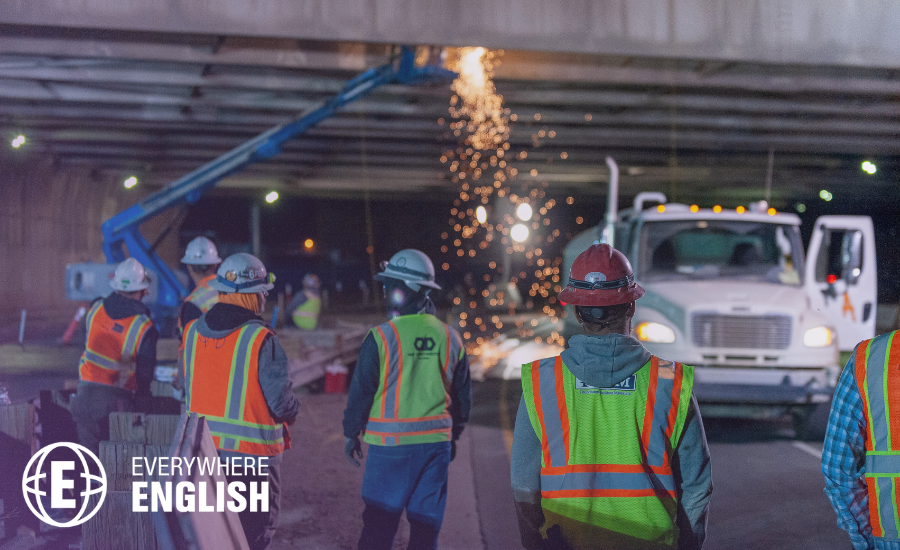
Construction days start early and end late, so training needs to fit around the rhythm of the work. Our courses are delivered online at times agreed with you, which in practice often means early evening sessions, with materials that workers can access on their phones during breaks. Nobody needs to travel to a classroom.
Sessions are live with a trainer and built from your world: your site paperwork, your toolbox talk topics, your real scenarios. Group courses build a shared standard across a crew, and one-to-one training suits a newly promoted supervisor or a key hire. Learners are assessed first and grouped by level, so an experienced worker with strong spoken English and weak paperwork gets different practice from a new arrival still building confidence.
A focused programme typically runs 8 to 12 weeks with weekly sessions. Winter, when many sites slow, is a natural window, and the skills are ready for the spring push.
What It Costs
Group training starts at €80 per learner per month, with final pricing based on team size, programme length and format. Set against the cost of one day’s delay on a programme of works, one failed audit or one reportable incident with communication in the chain of causes, the training pays for itself quietly and quickly. Site managers tend to notice the difference before finance does: fewer repeated instructions, fewer misunderstandings at handover, faster mornings.
Frequently Asked Questions
Can workers at different English levels train together?
- Yes, with grouping. We assess everyone first and split by level where numbers allow. On smaller crews, mixed sessions use shared material with level-appropriate tasks, so nobody is bored and nobody is lost.
Does the training help workers prepare for Safe Pass or the CSCS test?
- It prepares them for the language of those courses: the safety vocabulary, the question styles and the reading involved. It is not the certification itself, which workers complete through the official providers, but it removes the language barrier that causes capable workers to fail or defer.
What if the crew changes mid-programme?
- Construction crews move. New starters can join a running group after a level check, and leavers’ places can transfer. We build this flexibility in because a rigid enrolment model does not survive contact with a real site.
Do you train supervisors differently from general operatives?
- Yes. Supervisors need instructional language: giving clear directions, running briefings, correcting safely and writing reports. Operative training centres on understanding, confirming and asking. Both can run in parallel for the same contractor.
English for construction is delivered through our business English training programmes for employers across Ireland, Northern Ireland and the UK.
Contact us for a quote built around your crew, your sites and your start times.