
You’re considering English training for your team — or more specifically, you’re trying to get a handle on corporate English training cost in Ireland before you commit to anything. You’ve heard the success stories, you can see the gaps, and you know something needs to change. But before you can move forward, you need real numbers — ones that connect to your quarterly targets, your payroll, and the budget approval sitting on your desk.
So here’s what Irish companies actually spend on corporate English training cost in Ireland, what drives costs up or down, and how to calculate whether the investment makes sense for your business.
When it comes to corporate English training cost in Ireland, companies typically spend between €4,500 and €7,200 per employee each year. That covers live instruction, platform access, and regular progress assessments. Three factors determine where your number lands: delivery format, team size, and how sector-specific the curriculum needs to be.
Why the Format You Choose Changes Everything
Delivery format is the single biggest lever on corporate English training cost in Ireland. Group training through a blended learning model starts at around €110 per employee per week — roughly €5,280 per person over 48 weeks. One-to-one coaching for managers or key staff runs €70–€90 per hour, which adds up quickly when someone needs rapid progress ahead of an audit or international assignment.
Class size also plays a role in corporate English training cost in Ireland. Training five people costs more per head than training 50. Most providers reduce rates after ten employees, though some hold pricing until you reach 25 or more. It’s always worth asking directly.
Industry specialisation adds a further premium to corporate English training cost in Ireland — and rightly so. A generic business English course does less for your team than one built around their actual working day. Manufacturing teams need instructors who understand safety protocols and shift handovers. Pharmaceutical staff need language for SOPs, audit procedures, and regulatory documentation. That expertise comes at a higher price, but your team isn’t spending lesson time on vocabulary that has nothing to do with their work.
What Annual Training Budgets Look Like in Practice
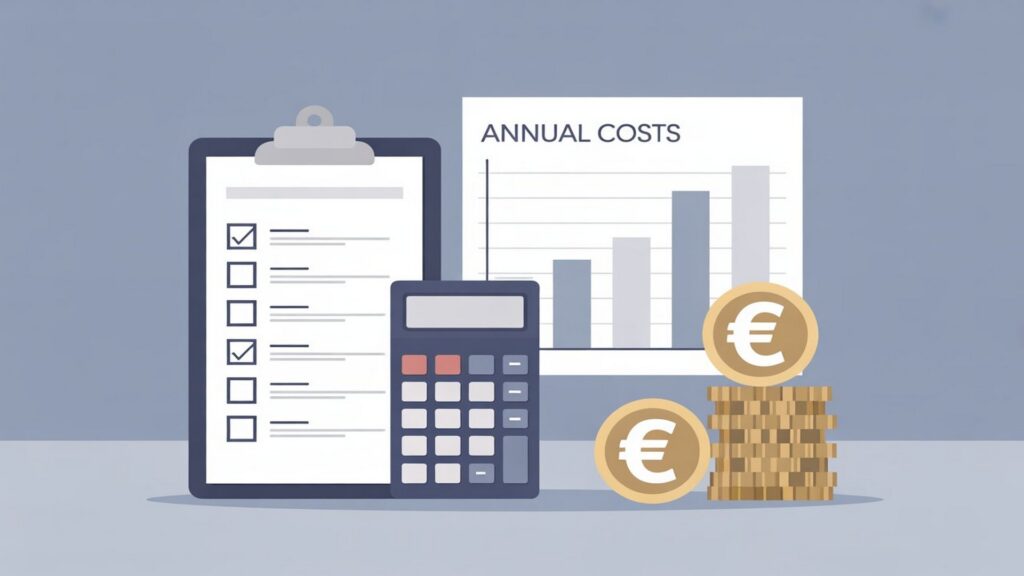
Most Irish companies structure their corporate English training cost in Ireland around 12-week blocks with two 90-minute sessions per week — around 144 hours of instruction per year. Here’s what that looks like for two different business types.
A mid-sized manufacturing company training 15 employees:
| Cost Item | Annual Amount |
|---|---|
| Blended group training (€110/week × 48 weeks × 15 employees) | €79,200 |
| Internal coordination | €2,800 |
| Initial assessments and progress reviews | €1,500 |
| Estimated total | ≈€83,500 (€5,570 per employee) |
A pharmaceutical firm training 5 specialists:
| Cost Item | Annual Amount |
|---|---|
| One-to-one training (€80/hr × 2hrs × 48 weeks × 5 employees) | €38,400 |
| Sector-specific materials | €2,000 |
| Quarterly assessments | €1,250 |
| Estimated total | ≈€41,650 (€8,330 per employee) |
One figure that rarely appears in budget conversations: employee time in training. Two hours per week adds up to 96 hours annually. Some companies count this as a training expense. Others treat it as professional development. Either way, it’s worth accounting for honestly when you’re building your business case.
The Hidden Costs Nobody Puts in the Budget
Budget conversations about corporate English training cost in Ireland almost always focus on trainer fees and platform access. That’s understandable — but it means you’re only looking at one side of the ledger.
Communication breakdowns drain productivity every single day. Employees working at A2–B1 level in English can lose several hours each week to misunderstood instructions, repeated questions, and clarification loops. Across a team of 20, that accumulated loss becomes a meaningful business expense long before you’ve spoken to a single training provider.
Staff turnover is expensive, and language barriers accelerate it. Employees who struggle to communicate confidently at work disengage quickly. Replacing a skilled worker costs an average of 33% of their annual salary. According to LinkedIn’s Workplace Learning Report, 94% of employees say they’d stay longer if their company invested in their learning. That’s a retention lever most businesses aren’t using.
Safety incidents carry a far higher price tag than training does. In sectors like English for pharmaceuticals, logistics, and manufacturing, language barriers contribute directly to workplace errors and compliance failures. A single serious incident can cost tens of thousands in lost production, regulatory investigations, and reputational damage — quite apart from the human impact.
How Skillnet Ireland Can Cut Your Training Bill in Half
Skillnet Ireland allocates €80 million annually for workforce development, and language training qualifies. Many Irish businesses use this funding to bring their corporate English training cost in Ireland down by 50–70%.
Private-sector companies can apply through one of 70 Skillnet Business Networks, organised by sector and region. Your company contributes matched funding — typically 30–50% of the total — and Skillnet covers the rest. To qualify, you need to be a private-sector or commercial semi-state operating in Ireland with the ability to provide matching funds.
Not sure which network applies to your sector? The team at Everywhere English can point you in the right direction. You can read about how government-funded programmes work and what they typically cover before you reach out. Most companies are genuinely surprised by how much support is available.
Comparing Training Formats at a Glance
Different formats suit different businesses. Here’s a straightforward illustrative comparison to help you decide where to start.
| Format | Typical Cost | Best For |
|---|---|---|
| Online group training | €90–€130 per person per week | 8–25 employees at similar proficiency levels |
| One-to-one coaching | €70–€90 per hour | Executives, rapid development, specific roles |
| Blended learning | €100–€120 per person per week | 5–50 employees with varied schedules |
| Intensive short programmes | Varies (€1,500–€3,000 per person) | Pre-audit preparation, international assignments |
Most Irish businesses opt for blended learning when weighing up corporate English training cost in Ireland against results. It combines structured weekly live sessions — where real speaking practice and feedback happen — with self-study access for learners who want to keep going in their own time. It also fits around shift patterns and hybrid working in a way that a fixed-schedule format simply can’t match.
When Does Training Pay for Itself?

Finance directors want a payback timeline when weighing up corporate English training cost in Ireland. Here’s one honest way to approach the calculation.
Start with the cost of the problem. How many hours per week does each employee lose to communication difficulties? A conservative estimate of two hours per week, at an average wage of €25–€30 per hour, produces a significant annual figure per person. Add any documented costs from errors — reworked production batches, misdirected shipments, customer complaints — and the total often exceeds the training investment before you’ve factored in a single benefit.
After six months of structured training, most employees show measurable proficiency gains. Instructions get followed more accurately, speaking becomes more fluent, and escalation loops decrease. After 12 months, you’re looking at employees who handle complex workplace communication without needing constant support.
The return doesn’t always show up in one line of your P&L. It appears in fewer safety incidents, lower staff turnover, faster onboarding of new team members, and stronger client satisfaction scores. Those gains regularly push training ROI well past 200% over a three-year period for companies with significant communication gaps. Want to see what that looks like in real terms? The client stories page shows the measurable outcomes Everywhere English clients have reported.
Making the Business Case to Senior Management
To make the case for corporate English training cost in Ireland, you need numbers, not a vision statement. Here’s how to structure the argument clearly.
Document your current costs first. Track communication-related delays for one month. Note errors that needed rework, customer complaints that stem from misunderstandings, and near-miss incidents where language played a role. This gives you a defensible baseline that makes the training investment look concrete rather than speculative.
Get an accurate quote for your team size and sector. Everywhere English builds programmes across manufacturing, logistics, pharmaceuticals, and general business — so you can compare costs genuinely relevant to your situation rather than working from broad estimates.
Apply Skillnet funding to your gross figure. A programme costing €60,000 before subsidy and €24,000 after it looks very different on a budget approval form. Show both numbers. Then use conservative projections: a 40% reduction in communication-related losses after six months, 70% after 12 months. Decision-makers respond better to cautious, evidence-based estimates with clear milestones than to optimistic assumptions with nothing behind them.
What to Ask a Provider Before You Commit
Not all providers deliver equal results at similar prices, and when you’re comparing corporate English training cost in Ireland, price alone is a poor guide. Ask these questions before you sign anything.
How do you customise the curriculum for our sector? A good provider will review your documentation, speak to supervisors, and understand your specific communication gaps before designing anything. Generic off-the-shelf content rarely produces the results that sector-built training does.
What proficiency gains do clients in similar companies typically see? Ask for examples from businesses of a comparable size and sector. Real outcomes beat general claims every time.
How do you track and report on progress? Monthly proficiency reports and management check-ins should come as standard. You need evidence that the investment is working, and so does your finance team. Everywhere English’s measurable progress and reporting includes an HR dashboard giving full visibility over attendance, grades, and learner levels in real time.
Can you work around shift patterns? Providers who offer flexible scheduling — including early mornings, evenings, and 24/7 self-study access — are far better suited to manufacturing, logistics, and pharma teams than those running a standard Monday-to-Friday timetable.
Your Next Steps
Getting clear on corporate English training cost in Ireland is the first step. Understanding what you’re currently paying for not having training in place is the second — and for most companies, that second figure is the one that gets the budget approved.
Start with a simple assessment of your team’s current English levels. A structured initial review gives you a proficiency baseline that makes budgeting accurate rather than approximate. Then track what poor communication is costing you each month. One month of careful observation almost always produces a figure that puts corporate English training cost in Ireland firmly in perspective.
Ready to find out what a programme for your team would actually cost? Book a free consultation with the Everywhere English team and let’s work through the numbers together!