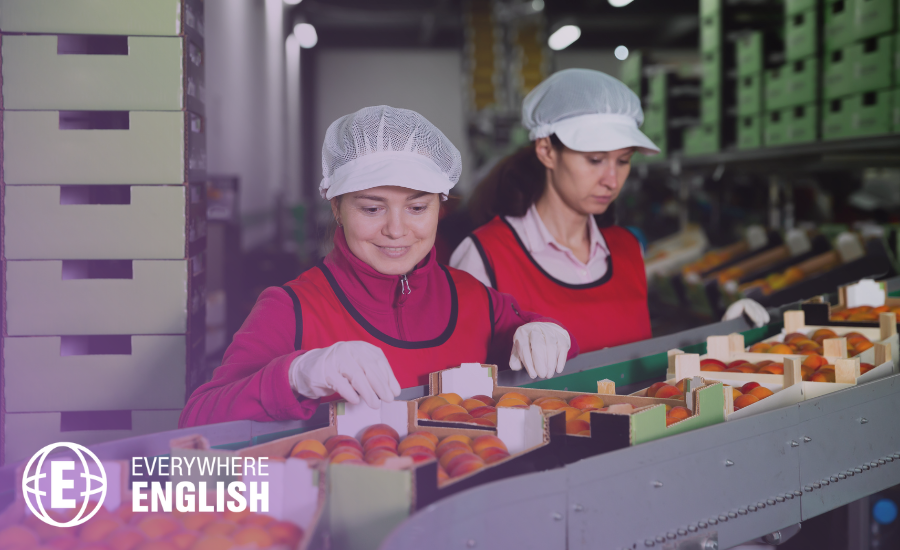
Walk into most food manufacturing facilities today and you’ll find something remarkable: teams drawn from dozens of different countries, cultures, and language backgrounds, working side by side to keep production lines moving. It’s one of the sector’s great strengths. But if your L&D strategy hasn’t caught up with the reality of that multilingual workforce, you may be leaving some significant risks, and opportunities, on the table.
We’re not here to tell you that your team needs to abandon their first language. A workforce that speaks four, five, ten languages is an asset. A workforce that also shares one common professional language? Now that’s an operation that’s genuinely hard to compete with.
The Food Manufacturing Environment Is Unforgiving of Miscommunication
Food production operates to some of the tightest margins for error of any manufacturing sector. You’re working with strict hygiene protocols, allergen controls, temperature regulations, and traceability requirements – all of which depend on every person on the floor understanding exactly what’s expected of them, every single shift.
When a team member misreads a label, misunderstands a supervisor’s instruction, or hesitates during an emergency procedure because they’re not confident in the language being used, the consequences can be serious. We’re talking about product recalls, failed audits, safety incidents, and the reputational damage that follows.
Industry-specific English language training reduces that risk directly. When your multilingual team members can accurately read SOPs, interpret allergen control procedures, and follow real-time instructions with confidence, your entire operation becomes more resilient.
Productivity Is a Combination of Speed and Clarity
Think about how much time is lost on a busy shift to miscommunication. A question that takes five minutes to resolve through a mix of gestures and broken phrasing. A task repeated because the first attempt was based on a misunderstood instruction. A handover that doesn’t quite land between shifts with different language backgrounds.
These moments are easy to overlook individually, but they compound quickly across a week, a month, a quarter. Managers often notice the symptoms like slower output, higher error rates, more rework, without connecting them back to the root cause.
When employees feel genuinely confident in their English, they are not hesitant about asking questions, they also start asking better questions, flag problems earlier, and engage more actively in the day-to-day rhythm of the floor. They don’t wait to be corrected; they communicate proactively. That shift in dynamic has a measurable effect on how smoothly a line runs.
Retention Is a Bigger Problem Than Most Manufacturers Want to Admit
The food manufacturing sector has a well-documented retention challenge. Recruiting is expensive, onboarding takes time, and losing experienced workers, particularly those who’ve been trained on your specific equipment and processes, hits harder than it looks on a spreadsheet.
Here’s something worth reflecting on: employees who feel out of their depth linguistically often feel out of their depth full stop. They may not voice it directly, but the experience of not being able to fully participate in a team meeting, not understanding why a process has changed, or feeling unable to raise a concern with a supervisor, builds quietly over time. And eventually, people leave.
Investing in English training sends a clear signal: we see you, we want you here, and we’re going to help you grow. That’s not just good HR practice – it’s good business. Companies that invest in their people’s development consistently see stronger loyalty, lower absenteeism, and a workforce that advocates for the organisation from within.
Career Development Doesn’t Have to Mean Hiring Externally
One of the most underused levers in food manufacturing is internal progression. You already have experienced, motivated people on your floor who understand your processes, your culture, and your standards. The question is whether a language gap is quietly preventing them from stepping into supervisory or technical roles.
The ability to lead a team briefing, liaise with a QA manager, or contribute to a continuous improvement project all require a level of English fluency that many talented floor workers simply haven’t had the chance to develop yet. With the right training in place, those individuals become your next generation of team leaders, and you fill critical roles with people who already know your operation inside out.
This is why the most forward-thinking HR and L&D leaders in food manufacturing are treating English training not as a remedial programme, but as a talent pipeline strategy.
Individual and Group Training — Getting the Balance Right
One size rarely fits all in a manufacturing environment, and language training is no different.
Individual lessons work well for employees on a fast track to supervisory roles, or for those who need specific language support — understanding technical documentation, preparing for internal reviews, or building confidence in spoken communication. The one-to-one format allows for targeted progress without the pressure of performing in front of colleagues.
Group sessions, on the other hand, build something that individual lessons can’t replicate on their own: a shared vocabulary and a team dynamic rooted in clearer communication. When a production team learns together, working through the kind of language they actually use on the line, it creates cohesion. People practise with the colleagues they’ll be talking to tomorrow morning.
The most effective programmes tend to combine both, tailored to the specific needs of the business and the individuals within it.
Ready to Turn Communication Gaps Into a Competitive Advantage?
Food manufacturing doesn’t leave room for ambiguity — not on the line, not in the audit, and not in the moments that matter most. If your multilingual team is skilled, experienced, and committed, the last thing you want is a language gap quietly limiting what they can achieve.
The questions worth asking aren’t complicated.
- Where on your floor do miscommunications slow things down?
- Which safety near-misses involved an instruction that wasn’t fully understood?
- Which talented individuals haven’t progressed — not because of capability, but because of confidence in English?
Those answers will tell you exactly where to start.
Contact Everywhere English today for a free consultation. We’ll help you identify where language barriers are affecting your operation and build a training programme that fits around your shifts, your team, and your goals.
Your workforce already has the skills to take your facility further. Let’s make sure language isn’t the thing holding them back.